Thursday, 16 August 2018

Chasing & Framing birds... birding in North America

I am sure this works for every birder like this only - you are going to a new place for birding, you spend time studying what to expect and you dream about seeing a few of these target species. Firstly, there is no way that it is assured that you will see the bird - secondly, as and when you see it - it might turn out to be a fleeting glance and finally for a person like me - the trophy hunt might not be what you thought it would be. After all - for a camera-wielding birder like me - carrying a trophy home is a very high priority.

I planned to cross the 'seven seas' (as foreign travel is known as in India), and bird in the USA. With that kind of travel, you expect a lot of lifers as the birds separated by such large distances over millions of years are specific to that land mostly - evolving in that land dependant upon the weather, flora, diet and a million other factors. Even the natural predators or the lack of it dictates how the birds evolve in a particular place.

Okay, this is how I do it - I travel to a far away country, dream about getting some target birds and when I am back home - picture of one bird that I clicked is framed and adores a wall in my house. When I prepared to visit America - the bird I wanted to hunt and carry as a trophy was 'Roseate Spoonbill' or a 'Painted Bunting'.

That being said - it always so happens that the 'Luck factor' - that one did not consider plays its part and they become - the 'Best Laid Plans'. This is never unexpected - atleast for me - I do spend nights dreaming about the million possibilities I may come across and even though I do have a dream trophy - I am really open to other possibilities.

In this blog - I would like you to please tell me - what bird should I frame? Below are some of the best pictures I have got of my 'Dream Birding trip to the USA'. I am also sharing my comments along with all the bird pictures that figure here.


Painted Bunting
The first bird that I propose is the Painted Bunting, a bird on my highly desirable bird to see and a bird that made me travel a total of 220 miles for this picture and only sighting. I give the credit of this sighting to my bird guide, Mr Bill. The colours are beautiful, though the perch is not natural - the bird is stunning, to say the least. I could have prayed and wished for a better perch, shade, shadow and a million things but I will still be at peace with this picture on my wall.

Eastern Kingbird
 A common, black and white bird, that was seen a number of times - each time I got drawn to it. I have, like a million pictures of this bird but this one is one of my best and from the closest quarters. That having said, I really had to give a ton of patience for this picture, almost moving at a top speed of a few inches a minute 😀.
Northern Cardinal
Common bird had a new meaning in my dictionary of birding with Northern Cardinal and the American Robin. Both these birds were seen from New York in the northernmost of my trip to Houston, the southernmost of my visit. Of course, the male is absolutely spectacular, but somehow it was not very easy for it to come and pose for me. When it did pose - it was a time of my life with me throwing every shutter sound I had. Alas - the session lasted the first click noise and this is what I got, like so many other times - the rest was, a bit of wing, foot, and a blur.

American Oystercatcher
Oystercatchers were beautiful and had to be on top of my birding list. Though the close encounter with this bird was only once, the encounter was worth its time spent got me the satisfaction that I might not have got at the best of the temple praying to the Almighty. The photographs I got did justice to that moment of time.

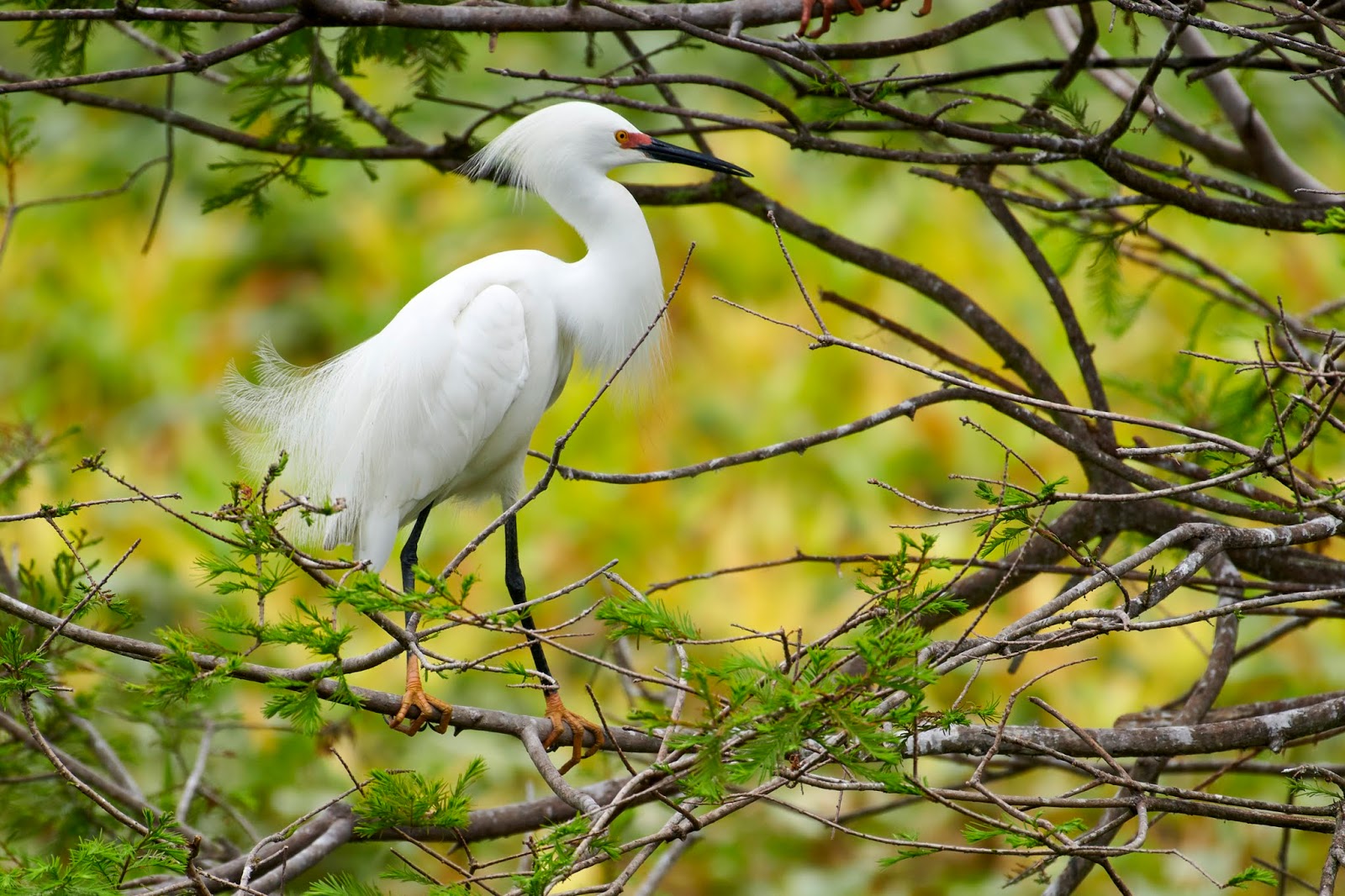
Snowy Egret
 Frankly, this bird was not the kind that I had decided to hunt. Having word 'Egret' suffixed made my preconceived mind to almost set aside the idea of chasing this bird. Well well well, imagine the surprise I got when I saw this one in full breeding plumage, it was an ecstatic feeling that one gets when you have achieved 'Nirvana'. Unfortunately, this remained one of the best images, clicked at Anahuac NWR.

American Pelican
A brown bird, the stories of which made me get goose pimples all over my body, a success story of American conservation that got this bird declining all over its range to be commonly visible. These are the small success stories that keep my faith in the human race. The bird was magnificent to say the least and to see it flying was out of world war series when bombers skimmed the wave tops going towards the enemy. To see it dive bombing the high seas in search of fish was another something. An experience that I will surely carry in my heart for a long time to come.

Laughing Gull
Though I did see it troubling the people all over the place - this beauty of the bird, like so many other gulls are not really afraid of humans. That gave me an opportunity to wait for it to sit nearby and pose before I clicked the shutter and shot it a million times over. I am including this bird in my list even though some people may scorn over my choice.

White Ibis
A near perfect perch for this beauty of a bird. Ibis is one bird seen in my visits to all the continents I have touched for birding, Indian Subcontinent, Africa, Australia, Europe and now America. The basic characteristics of the birds remain the same but the awesomeness of all the subspecies I have seen does not diminish. I am once again grateful for my bird guide, Mr Bill to position his truck in which we had gone birding in a perfect position to get this picture.

Yellow-crowned Night-Heron
 The Yellow-crowned Night-Heron was pretty as expected, what I had not imagined was the nature of the bird - that would let me get some good snaps. The first time I saw it was in Sheldon Lake State Park. I almost went down to a crawl to get near the bird and get some worthwhile sightings. After that first day - every day was a Bonanza - with the birds all around in all drains - just name it. I have got a few shots of this bird and will not mind framing this beautiful bird to adorn my wall.

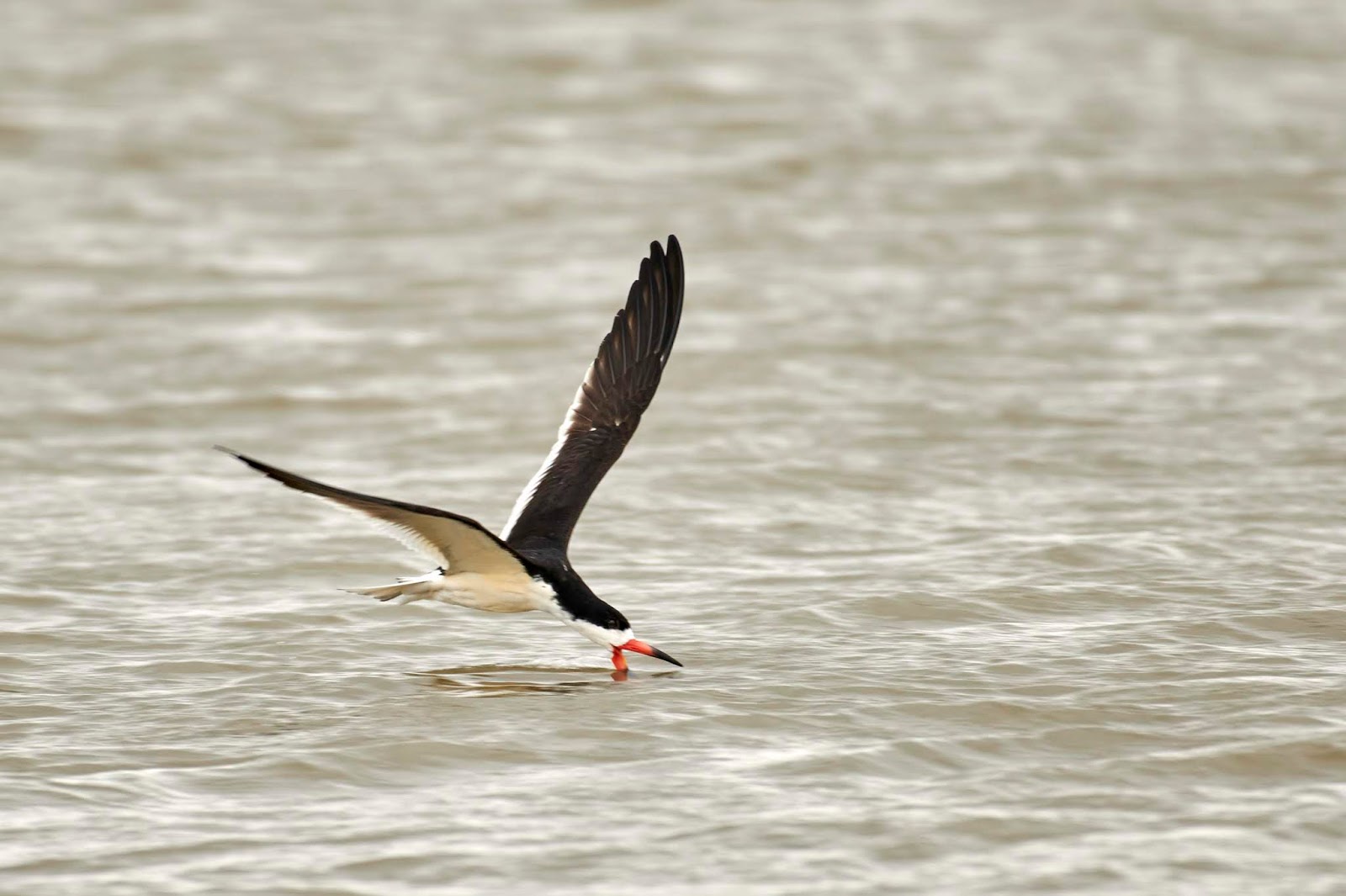
American Skimmer
 Skimmers were on top of my priority and saw them twice in the US. Both time in Texas with my bird guide. That is where the happy story ends. The first time - they were sleepy and dozing off at a distance. The second time over they were skimming the fish in the seas and I shot not less than a billion photographs - and as they drifted away I had a satisfied smirk on my face. It vanished the moment I saw my pictures. They were horrible. I had left the camera at some God forsaken settings and almost all were a washout. Oh, how I wanted to kick my butt. Here is one that is highly cropped and somewhat looks like the bird I saw - only thing is it is nowhere I wanted. All the same, it figures here as there is no other bird that is like a skimmer...

Roseate Spoonbill
Picture no 2 of a pair of Roseate Spoonbill. The chicks are not theirs just for record sake

Another bird that was top of my wanted list but unfortunately this one, though seen fairly close did not give me the kind of pictures I had dreamt off. I have included two pictures that I picked out and did not want to leave either. So I shall leave the decision in your hands. The bird is beautiful and thinking back on my time spent there - I wish I had more time with these beauties before moving on.


Northern Parula 
It is actually a shame that more number of Warblers did not make to this list. All the warblers that I saw there were stunning but as expected they hardly sit still for more than a second and be a photographic subject. This one bird that was busy singing on a tree did give some shots, but being in harsh shadows, I hardly call this the best of the shots I had expected.
Sora
This bird makes to the list with an interesting story behind its sighting. We were travelling on a birding trip with our bird guide, Mr bill and it was just a flicker of a bird that was seen. I almost jumped out of my seat as I shouted Mr Bill to stop for the bird. Oh, my Indian habits of shouting and stopping, well will keep that part of the story for some other day. Bill was gentleman enough not to shout back, stop the truck and take to to the place I said I spotted the bird, the bird too was kind enough to stay there for some more time so that I could validate my sightings. Though the drain was thick with reeds - it did come out for this one shot and here it is - making to my top bird list.

There are so many birds that should have made to this list but birding is not easiest of a passion and sport to pursue. Below this, I will list out the birds that deserve an honourable mention, even though they did not make to this list. Do Vote - will eagerly look forward to your comments and choice of bird.

Cedar Waxwing

American Robin

Golden-crowned Kinglet

Wood Duck

Bufflehead

Carolina Wren

Black-bellied Whistling-duck
 Already voted by me one of the prettiest ducks seen by me in the US, ahead of Wood Duck, unfortunately, did not make to the final list of mine - a vote can move it up though.
Eastern Bluebird 
White-winged Dove


Ruby-throated Hummingbird
 Hummingbirds were very very high on my priority list, and I did get some shots of these beauties. The first time I saw them - they were just like bugs flying across my ears. I appreciate them and meaning they give to life. Unfortunately, the best of my pictures do not do justice to what I wanted. Some other time - I suppose.
Whimbrel

Willet

Great-tailed Grackle

Boat-tailed Grackle

Red-bellied Woodpecker

Great Blue Heron

Sunday, 1 July 2018

American Oystercatchers...

I always am in awe of Oystercatchers. Though they are found in India too - the Eurasian Oystercatchers - that travel all the way from Europe to India. Unfortunately for me - I was yet to see them here.

Though this bird was clicked during my visit to Sandy Hook, I post it first as I think this is my finest snap...

The closest I ever got to them was during a cruise for spotting whales while on my trip to Australia and that too seemed like from a million miles away. When I was preparing and packing for my trip to the USA - this bird was one of the must-see birds. During my stay at New-York - as we were driving along the coast - I thought I saw a pair fly in the far distance. Unfortunately - from the moving car, though my heart was excited, I refrained to log my sighting lest it gets a tick on my life list and there remains a small doubt in my mind that would nag me forever. But having got a glimpse - I was sure that these birds are around and will eventually show themselves one way or the other. 

The wait was killing and I was on a lookout when I visited the Great Kills Park, New York. I saw a pair flying off in a distance - and though they were close enough for me to see and observe - they denied me the pleasure of the great picture that I wanted.

It was my visit to Sandy Hook that I could hunt them down. Once again I saw a pair in the distance and I plotted the track that I thought will take me to the beach where they were headed. The walk was just about a kilometre or so but first few hundred meters took me through the thick bush that gave me ample diversions with birds chirping here there and everywhere. I looked around the track - marked the tree where the birds seemed to be in a feeding frenzy and without wasting any time continued forward - I just did not want to miss the oystercatchers. 

In case you were wondering why the sightings I had till now were in pairs - the reason was perhaps simple - the birds are 'monogamous' - taking one partner at a time (or even for the entire lifetime - if some reports are to be believed) - hence the sightings are two birds at a time or even numbers generally other than when they are with chicks. 

Birds flying around me keeping a keen eye...

...and yes they were calling too - that is what made me retrace my steps and go back.

Coming back to the story - as I neared the beach - the sand dunes blocked my sight to the shore and I virtually rushed up the dune to peer down - and there in the far distance I could see a pair by the beach. That was still about 500 yards to go before I could see and photograph them. I started walking the walk - typical of birders - don't walk directly towards the bird, do not look or stare at it. Stop every few yards and do nothing - especially pointing the Bazooka of a camera towards the bird till it shows a certain comfort level in your presence. It would have taken me not less than 40-45 minutes to approach them and then - when I was close enough I had a time of my life clicking pictures of my dream birds. I sat down near them and soon they were all around me - they flew around many a times, keeping an eye on me only to land back where they were - and this was the time - I suspected that I might be near their nesting site - as nest that is nothing but a depression in the sand with eggs laid in centre. I got up and slowly walked back, following the footsteps in the sand that I had made coming to this point. As I entered the thick bush - either I was lost or the birds that I heard in the trees had moved on - and thus ended my best ever sightings of American Oystercatchers. The birds with hypnotic eyes.

Tuesday, 12 June 2018

Hunting New World Sparrows...

Preparing for the US birdwatching visit sprung a surprise that I was not expecting at all. Living in India where we have six species of sparrows, I always felt that the sparrows -were mostly the Asian thing. Out of these five are in and around my city off and out of those - the house sparrow, native to India has been introduced knowingly or unknowingly in the entire world as to say. It was on all three continents that I visited - Australia, Africa, Europe. 

As I studied the sparrows of the US - I realised that what I had taken for granted that all over the world the 'Warblers' were the Little Brown Jobs, well that did not be turn out to be true as I travelled North America - the warblers were mostly colourful and not the brown jobs that I had expected. Infact, on digging a little more, I was surprised as the sparrows in North America are categorised as the Little Brown Jobs. Hell, and there was more - there are no less than 38 sparrows in the USA. I still did not realise what trouble was to greet me - the sparrows were migrating and they were virtually everywhere - and they were mostly difficult to identify, perhaps because the plates in the book were not as easy to understand. Though the birds were mostly beautiful still - like so many other birds the females were a pain for me to ID. Slowly and steadily I starting seeing, understanding and recognising the sparrows that I saw. At the end of my trip I had seen nine sparrows of North America. This includes the House sparrow - a bird not native to the USA but very common everywhere I went. Considering the total sparrows there in that country is but a small figure - but I am fine and satisfied with the birds I saw and will carry the memories of these 'Little Brown Jobs' of New world for a long time to come - till we meet next I would say.
White-throated Sparrow (photographed in Highland Park, NY)
White-throated Sparrow (Photographed in Central Park, NY)

I would have ordinarily started with the House Sparrow - by large the largest count I had there and get over with but I will save it for the last. I will start with the sparrow that I feel was the most beautiful by my standards. I would classify the White-throated Sparrow as the one - mainly because it was beautiful and more importantly gave me opportunity to see and appreciate the beauty (besides some good shots). This bird is a mid sized Sparrow and a beautiful one at that.
My second most photographed Sparrow of the visit. Chipping Sparrow (Photographed in Forest Park, NY)

These sparrows were crisp and clean - wonder you can get what I want to say (Photographed in Central Park, NY)

Another photograph from Central Park, NY

The second sparrow, Chipping Sparrow that I saw was also breath taking beautiful and comes a close second. Why it came second? I really have no reason at all. But since two of them could not be classified as first - so this one is there in the second slot. Also this is one sparrow that I saw at both the New York/New Jersey area and Texas. Its a clean and crisp with bright rusty crown. This one sparrow - whenever flushed sat on flowering bush / trees and were just beautiful. The time of the year also seemed right for them to sing songs to me.
These birds were fairly common in the parks of NY and New Jersey.

It was often found foraging with other sparrows, like the House sparrow in top right in this picture.

Next sparrow that I would list here is the Dark-eyed Junco. Though named Junco, this bird is a medium sized sparrow and I was told that there is a lot of geographic variation based on geography. What I saw was the Slate-coloured variety and came across it fairly regularly in the parks and the forests I visited including the Central Park, NY. Had I not read about it - I would not have called it a sparrow at all because of the appearance, the pale bill and the well rounded head. But as an after thought the bird did forge on the ground like a sparrow.
This bird was spotted by Bob based on its song and I was so very glad to come across it. (Central Park, NY)

You can easily loose this bird in the dry leaves of a fall. Inspite of the bird a few feet from me - it took me time to pick up the bird and that too based on its movement.

Next group of sparrows are the ones that troubled me as far as ID is concerned. The first one is the Fox Sparrow. When I was tying up with Bob for birding in Central Park he excitedly told me that the Fox Sparrows are here. It instantly became my target to hunt and I saw this bird on two occasions in Central Park and that more or less remained sighings that I had during the trip. The good part was that of the two sightings - one pointed out by Bob was singing as he followed the sound like a hound smelling the blood and that gave me some good views, although not all that good pictures due to the shrub. The Fox sparrow is rich reddish and large sparrow. It has a thick bill and spotted underparts. It was beautiful in its own sense.
This bird stopped singing the moment I spotted it. I waited it to start again but perhaps I had caught a bathroom singer who was too conscious of audience. (Photographed in Great Kills Park)

I wondered if the death-wish of a sparrow looks somewhat like this - sitting on a sign that clearly tells the bird that there is an Osprey Platform around. 

Once again the central spot that I have mentioned below is clearly visible in this Song Sparrow

The second confusing sparrow, the brown one was the Song Sparrow. It is a medium-sized sparrow and I came across this bird at three locations - Central Park, Great Kills Park and Sandy Hook. Though confusing the bird was in mood to sing so spotting was easy and once I knew the song it was even easier. The other was the central spot on its breast. It was also surprising to learn that the songs of the bird vary regionally.
Field Sparrow - the last sparrow to be identified by me (Photographed in Sandy Hook, New Jersey)

Field Sparrow

I believe it has a very peculiar song - but I seemed to have missed it.

This next sparrow was an absolute beauty of a bird and unfortunately it took me almost two weeks before I could ID it. Firstly, the bird was spotted only at the Sandy Hook, New Jersey and secondly the book and the birding app did not justify the red beak that I saw in the field. It was only after I met Bill (Birdguide in Texas) that I asked him and he identified the bird as Field Sparrow. The sparrow was small and slender. There was a white eye-ring that confused me and threw me off the course while trying to ID it by myself. All the same - seen it once and the bird now cannot be mistaken ever again. Too beautiful, full stop.
Highly cropped shot of Swamp Sparrow (Photograph from Central Park, NY)

An by-chance encounter with Swamp Sparrow (Photograph from Dismal Swamp)

The next was the bird that yet again confused me no ends. The Swamp Sparrow. Bob asked everyone that the Swamp Sparrows have been spotted in the Central Park and have started arriving - and anyone who finds them gets a Hurray. That said and the adrenaline started doing its job - every bloody sparrow I saw after that seemed like a Swamp Sparrow - finally I was too embarrassed to point out the one I saw and actually turned out to be Swamp Sparrow. They were - well kind of everyday sparrows ;-). Medium-sized, Grey face, neat white throat and a rusty collar. Well I am talking about an adult - an immature or non-breeding - would have been like any other sparrow. This was also the sparrow that I photographed from the furthest and have pictures - nothing to write home about.
A fine bird that had a strong yellow eyebrow that made ID easy. (Photographed in Sheldon Lake)


Had to take multiple pictures to ID this bird. Turned out Savannah Sparrow with misleading eyebrow ;-)


So far the yellow shows well for ID

The last of the true sparrow of North America that I witnessed was the Savannah Sparrow. This incidentally, other than House Sparrow, was the only Sparrow that I saw in the north in NY and New Jersey and in the south in Texas. The bird is beautiful like other sparrows and was fairly distinct for recognition due to the yellow eyebrow. Unfortunately this bird also has whitish eyebrow and those are the times that led to identification crisis. This sparrow too is a mid-sized sparrow with a fairly broad bill. 
Male House Sparrow (photographed in India)

Male House Sparrow

My my - now we come to the introduced - House sparrow. This was one bird that I had the greatest count numbers from New York to New Jersey to Texas. Seeing them over and over again and from India to Australia to Italy - this bloody sparrow is everywhere. I was so busy looking for other birds that inspite of seeing them so commonly during my visit - my mind filtered them and set them aside so much so that when I started writing this article I realised that I do not have even a single picture of the bird from my visit. So the pictures that you see above are from India, taken a month before my visit to the USA.

If you have reached the end of this blog - you really are a bird lover so I will end this with a request. Do follow - write to me and interact - brickbats and good wishes are equally welcome. I do not do this for any kind of monetary benefits - but just about sharing the writings to spread awareness that there is a world other than the humans that Almighty created that is perhaps more beautiful and it has to be looked after. Kick your kids out to spend more time in nature. Do what you can to help nature and its all encompassing beauty.

My birding in the USA can be classified as success and the success in no small measure goes to two birdguide that I came across there. If you ever need them, contact details of Birding Bob (for birding in Central Park) and Mr Bill (for birding in Texas)given below. Both of them were great birders, good human beings and wonderful Bird guides.

Birding Bob - https://www.birdingbob.com/ (all details and schedules are available on his website)
Contact 347-703-5554 (US number, use the country code)
email: rdcny@pb05.wixshoutout.com (Mail him after establishing contact as the emails tend to be trashed if not from known ID)

Bill the birder - Bill Goloby, Director, Penfeathers Tours, LLC
Contact: 713-542-3473, 832-698-1175 (US number, use country code)
email: pfcompany@aol.com