|
| The Awesome Team... |
Introduction
Sitting in the aircraft on my way back to Chandigarh - I drifted off and on from my state of half sleep. Had been running around the bushes for six complete days. That coupled with a running fever - it was killing but of course that did not deter me from chasing the feathered friends. In between one of those sleep induced trance - I called for the Flight Attendant and after introducing her requested to inform the pilot the he should announce the Mt Everest as we passed along. Before long the pilot was on the announcement and told the passengers that the mount everest was the peak covered in the haze of clouds. After looking out and not getting a good view, I felt it was a waste of time and efforts managing the F Seats to get ‘the view of the Great Everest’. I drifted off to sleep once again - drifted to flying in towards the little birding heaven of India.
As I once again faded to sleep - the dreams kicked in fast and transported me two months back. It was a day when the Birding trip that I was so hopeful of planning dashed as no one was ready to give me company and I chose Sikkim as the alternate site and started a campaign - posting first on Chandigarh Birds and then on Hyderabad birds. The response was hardly anything to talk about - three calls from Chandigarh Birds and one from Hyderabad birds. After repeating the plans, the budget and everything - no response. I took is fine I suppose - as I almost forgot everything about it.
One day - 15-16 days to go to the chosen date - I got a call from Narbir. ‘Col Sahib’ - what happened to your plan of Sikkim birding ? I replied no one has volunteered and the most economic viable model has to have four birders in the group. He said I am ready - so are you, so was Rima. Alpana had mentioned that she would let me know some time back to I rang up to ask her an update. She responded ‘Affirmative’ and the plan was on track and rocking.
Planning
I immediately made a whatsapp group and started the coordination and planning - after all this was the real purpose of technology - and not the ‘passing stale jokes’ and ‘Gyan' on whatsapp. I had infact done some homework that had got me to the ideal group size of four. Firstly in veh like Innova or one of the jeeps can carry comfortably four plus one driver and the luggage comfortably, and as far as the veh goes - you pay for one the same amount - for four also the same. Secondly the room sharing gets the budgeted to half.
I was very unfortunate to have an extremely bitter experience at this stage that I would like to share. I actually wanted to have a

Bird guide all along the trip and after searching for them I stumbled across a website
www.goingwild.in and got in touch with Mr Dibyendu Ash who conducts the tours. I was in the process of negotiating with him where in he had asked for ₹ 64,000/- for five days birding to include homestays, food and veh for four. At one stage I asked him what birds are likely, what are the target species and what count did he expect in these five odd days. Suddenly there was no response from him. He stopped picking up my calls. At first I thought that he would be out conducting some tour/was busy/was indisposed, but as our days of travel drew close and hearing no response from him made me panic and I sent him a message to which I got a very funny reply. He basically told me that he is afraid to pick up my calls. I might have accepted this with a pinch of salt but later I came to know that he had got a bigger group during the same time so he broke up with me. It broke my heart too, and the days were closing fast and I had work to do. I let this incident behind me and started doing my own thing. Veh, check, accommodation, check… so on and so forth. All things tied up the trip was on track and rocking.
I will kill the details of bookings here - for those who may look forward to them
Stay at Zuluk: Army Transit Camp (privilege of being a retiree)
Stay at Neora Valley: Neora Valley Jungle Camp, all bookings only via Help Tourism (+91 353 2433683)
Stay at Kewzing: Bon Farm House via Chewang Bonpa (a great person and birder himself) (+91 954 7667788)
We reached Bagdogra airport in the afternoon and immediately got hold of the Veh and started the journey to Zuluk. The traffic was bad and by the time we reached it was dark - so we had dinner and hit the beds.
 |
| Looking back at Zuluk - it was still lights out time when we were climbing the mountain... |
 |
| First rays of sun lighting up the mighty Kanchenchunja |
 |
| First day of birding - on our way from Zuluk |
 |
| Hold your breath - the birding is about to start |
 |
| Wating for the light enough for us to see... |
 |
| Till the birds are visible - here we are training our guns to the Kanchanchunga, Narbir to the Left and Rima to the right |
18 Feb 2016: Early morning, much before the sunrise we were up and on the road heading for seeing pastures and birds upto 14,000 feet. Birding was not too good but the serenity, the peace was worth the effort. As we climbed up - and looked back the famous winding ‘Jalebi turns of Zuluk' were all there. As the sun slowly creeped up the first rays lit up the mighty ‘Kanchenjunga’. It is interesting to mention a few words about this peak - till 1852 this was considered the highest peak in the world. However, based on calculations done by Great Trigonometrical Survey of India in 1849 - it was concluded that Mt Everest is the highest mountain in the world and relegated Kanchenjunga to be the third highest peak. Highest/second highest or third highest - it does not take the glory of seeing the first rays of sun illuminating the peak. A sight to see and behold. As the day broke we started looking around for our bird sightings. The sightings started - not the density of birds expected but then lifers for me. The birds seen were the White-browed Rosefinches, Alpine Accentors (great posers), Winter wren (a bird given the crown for posing for us for the day), Rufous-vented Tits, Snow Pigeons, Blue-capped Redstart and few raptors like Himalayan Griffon, Common Kestrel and Upland Buzzard (seen by Mrs Alpana). We carried on till about 14,000 feet plus of altitude till a temple known as ‘Baba Harbhajan Singh’s temple’ on the road to Kuppup. After spending some time here we turned back to Zuluk, had a quick bite and were on our way to the next stop - Lava.
 |
| White-browed Rosefinch (Male) |
 |
| White-browed Rosefinch (Female) |
 |
| Rufous-vented Tit |
 |
| Eurasian Wren (winter wren) |
 |
| Eurasian Wren (winter wren) |
 |
| Alpine Accentor |
 |
| Common Kestral |
 |
| Habhajan Singh Gurudwara - we turned back from this point - aprroximately 14,000 feet |
Moving for Lava we were covering a stretch from about 10,000 feet to 6,000 feet. Here we had primarily shrubs, bamboo and grass giving way to broad leaf trees, Oaks, Rhododendrons and the like.
While travelling down to Lava we used to peep out - at the first sighting of a flutter or a chirp - brakes were applied, all dis-embarked and out looking for birds. As we drove down, moving below 10,000 feet the Alpine shrubs and pastures gave way to lush green and dense evergreen forests. One can get a sense of the birding enthusiasm by the fact that when we paused in-between to check our progress we could not believe that we had covered just 10 odd km in last six hours. We pledged not to stop the way we were - at every chirp and every movement along the road - that pledge was broken after exactly 10 minutes when we came to a place with abandoned Army Barracks. The place turned out to be a birding heaven. One to two mixed hunting flocks and I can speak for myself - I was a little kid who was so overwhelmed - just did not know where to see and what to look. There were birds, birds and birds each one more colourful than other and each screaming attention. Parrotbills, Rufus-capped Babbler, Streaked Scimitar babbler, Hoary-throated barwings were some of the list of birds we saw here. All the sightings day wise are appended in the end of this blog. The birding here along this route was so crazy that we reached our guest house at Lava in the night.
 |
| Rufous-winged Fulvetta |
 |
| Hoary-throated Barwing |
 |
| Black-throated Parrotbill |
 |
| White-browed Fulvetta |
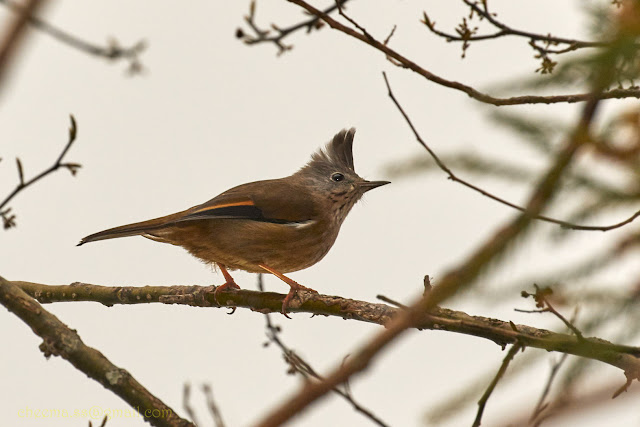 |
| Stripe-throated Yuhina |
 |
| Black-throated Parrotbill: it took two days of sighting this bird and around hundred clicks to get it to face me... |
It was somewhere during this stretch that the proposal to increase the stay by one day was floated - promptly seconded by others and the hard task of informing our spouses and those waiting at home commenced. I took the lead by calling up - giving some reason that I do not recollect and bingo - I was in the clear. For the rest of them the battle did take a day or so to sort out. We changed the tickets - bearing out some additional cost to the planned and we were good.
19 Feb 2016: The day started early and after a self made tea in the morning we were moving around, killing time to the breakfast. The trees within the complex were buzzing with activity. We did a quick trip to the gates - that were about half a km away and the main birds during that period were the Small NIltava, Stripe-throated Yuhinas, Rufous Sibia. The entire valley were covered wit dense broad leaf forest and in places the visibility in the bush was very poor. We could hear and spot a flurry of activity - but before we could look in details the bird had gone. Rufous-throated Partridge and Hill Partridge sounds were echoing in the entire valley but no luck with the sightings.
 |
| The bloody laughing thrushes that refused to come out of the bush: Black-faced Laughingthrush |
 |
| Stripe-throated Yuhina |
 |
| Grey Treepie |
 |
| Blue-fronted Redstart |
 |
| Rufous Sibia |
 |
| Neora Valley Jungle camp gate: Left to right - Rima, Self, Narbir and Alpana |
I played a call and we had a quick response by the Black-throated sunbird - unfortunately it disappeared as fast as it came out to investigate. All the same had a good sighting (No shots unfortunately) The weather was bad as bad it could be - I am purely talking from the point of view of my photography - the overcast sky was dark and camera was having a tough time spotting and focusing. After breakfast we decided to go to the famous pipeline and thereafter, after lunch to Kolakham village and beyond to a waterfall. That walk was amazing with so many birds. The list of lifers was on a back burner - with Dark-breasted Rosefinch, Dark-chinned Yuhina, Orange-bellied Leafbird, Rusty-fronted Barwing, Golden-throated Barbet to name a few. There were others too and the detailed list is at the end. We also came across sub-species of Long-tailed Shrike - and had not been for Narbir and Rima - I might have named and recored it as some other exotic species. As we came back for lunch there we had again a big mixed hunting flock lead by the Black-throated Parrotbills. There was a sighting of a wren babbler too - but it disappeared - never to be seen again so the exact identity remained a mystery. Another notable bird the we came across was the single Maroon-backed Accentor. There were many laughing thrushes but I fail to understand why they could not take out a moment to pause and show themselves in the open. Not one good shot recorded that day. By the time we were back - very very unfortunate for me - I started running a high fever and had to go back to the room for a nap. I did miss a lot of fun - with the three of them - Narbir, Rima and Alpana walking to the gate and back two odd times and showing off the great shots they got there.
 |
| Russet Sparrow and two Chestnut-crowned Laughingthrush |
 |
| Himalayan Bluetail (Female) |
 |
| Striated Laughingthrush |
 |
| Dark-breasted Rosefinch |
 |
| Long-tailed Shrike |
 |
| Same Long-tailed Shrike pictured above... |
 |
| Red-vented Bulbul - definately darker and brighter than one found in North India |
20 Feb 2016: The morning did not get me too much relief but there was no way that I was missing the fun so after a quick breakfast we were in the vehicle and heading for Chenwang Bonpa’s Bon Farm House. I am sure that after reading the time we took for covering 10 km on the day two you can easily guess - Yes we took the entire bloody day to cover the 100 odd km from the Jungle Valley camp to Bon Farmhouse. The birding enroute too was fabulous. We were looking forward to the famous - birding at the first mile - unfortunately road repair/widening seemed to have taken the toll. The entire roadside was covered with dust and hardly and birds. Enroute we had such at Rangpo - crossed the Teesta river and entered West Sikkim. Once again the birding started with earnest - one tree with Ha-rcrested Drongos, Great Barbets, Red-vented Bulbuls to name a few. As we again had a fair idea that we are going to run late - we yet once again decided not to stop till we see something out of the ordinary for all of us. I might have uttered these words and there we were - yet again stopping and admiring another set of birds like never before - here we had Ashy Bulbul, Maroon Oriole and dozens of warblers flirting all around us. Then there was Plumbous Water Redstart that gave us a great pose - since it is a fairly common bird towards western Himalayas - we stopped click, click and moved on. We would have moved just a couple of yards away when in the distance we saw- what appeared like doves on a tree in a distance. We moved on, but somehow some better sense prevailed when we stopped again - peered through binoculars and cameras - Vola - there were no less than 20 Barred Cuckoo Doves. It was a sight to behold - and we were fortunate to come across another three four groups of these doves that day and the next. Then there were these laughing thrushes that just plain and simply refused to get photographed. We reached finally with the failing light and Mr Chewang Bonpa was there to greet us. We had a cup of tea, a quick shower and were ready for dinner. During dinner we had the anticipated excited discussions of the sightings of the day and though the aching bodies were ready to fall of to sleep - there was one more thing to be discussed. The next day birding plans with Mr Bonpo. Mr Bonpo did one grave mistake of asking - what birds would you like to target and in a millisecond Narbir fished out a list of 200 odd birds and put it in his hand. I burst out laughing and there were grins on the faces of the ladies - Mr Bonpo however stood fast with his poker face and poured over the list. After a few moments of deliberations - he replied in a tone of a true monk - Ah this list I can do - but you will have to spend a month here. There was once again a fiery attempt by Narbir to now shortlist the must see birds. There was no way we could have remained awake any longer - atleast I can speak for myself as my aching body just wanted to sleep. The fever was just in control for the time I was popping in medicines. I would have hit the bed and fell asleep in a moment. There were no dreams that night.
 |
| Dark-breasted Rosefinches near the village (Male to right and Female to left) |
 |
| Dark-breasted Rosefinch |
 |
| Rufous-breasted Bush Robin (was earlier incorrectly identified as Rufous-bellied Niltava) |
 |
| Golden Fronted Barbet |
 |
| Blue-throated Barbet |
 |
| You will have to take my word for it - this bird is the Ashy Bulbul. Unfortunately the distance, and the bird just gave me this one shot before it flew off. |
 |
| Spangled Drongo |
 |
| White-crested Laughingthrush |
 |
| Barred Cuckoo Doves |
 |
| Black-throated Prinia |
 |
| Eurasian Tree Sparrow |
 |
| Stripe-throated Yuhina |
 |
| Yellow-throated Fulvetta |
 |
| Darjeeling Woodpecker |
 |
| Maroon-backed Accentor |
 |
| Rusty-fronted Barwing |
 |
| Black-faced Laughingthrush |
 |
| Bay Woodpecker |
 |
| Himalayan Bluetail |
 |
| Same Himalayan Bluetail as above |
 |
| Maroon Oriole |
21 Feb 2016: We all were up at 4 am in the morning. A quick shower and we were out with our guide to area around Maenam Wildlife Sanctuary. Birdwatching with a guide who has the local knowledge is a great experience. Mr Bonpo on top of it was aware of behaviour, sounds, movements of a great variety of birds. He could single out a call and whistle the bird to him. The day was as great as we expected it to be. We saw Fire-tailed Myzorins (no pictures - bloody birds were too fast, too small and in the darkest of thickets) The a good look at huge Bay woodpeckers, the brilliant Darjeeling Woodpeckers, Maroon-backed Accentors, Black-faced Laughing thrushes, Rufous-winged Fulvetta, Yellow-throated Fulvetta to name a few. The Rufous-throated wren babbler responded to a call by Mr Bonpo but was too shy to show itself. Then there was Shikra, Mountain Hawk Eagle and Mountain Imperial Pigeon. We had to stop birding because of our collectively grumbling stomachs and after a short break for a quick lunch we were on the road again. This time we were in luck to get good sightings of Sikkim Treecreeper (Brow-throated Treecreeper), red-tailed and Blue-tailed Minlas and Rufous-faced Warbler. We heard a Hill Prinia, and we stood there some time waiting for it but after a while we just decided to move on. The sun was setting - and the hill sides were getting dark - I cursed - as to why the day could not have been longer - went back and dropped dead asleep. Ofcourse who told you I did not have dinner - I did have dinner and it was only after that we passed out. The day was fabulous to say the least. That day we faced another great problem with the Jat Agitation getting out of control and our Taxi refused to position the cab next day for out travel from Delhi to Chandigarh. Because of that the cost of air travel in the sector shot skywards. Unfortunately we had to make do with it and Mr Narbirs better half proved invaluable - sitting in Chandigarh to plan and book our air tickets to reach back.
 |
| Outside Bon Farm House, Left to Right: Narbir, Alpana, Rima, Bonpo and me |
 |
| White-tailed Nuthatch |
 |
| Could not really identify the minivet. The bird gave opportunity for this sot only |
 |
| The Parrotbill that showed its face... |
Conclusion: We had a wonderful birding trip - barring the experience dealing with Going Wild. We promised ourselves to return again the first opportunity we get. I do not know about others - I had just one regret - the trip was too short - but then the job dictates, and so does those waiting for you back home. East India presents a great birdwatching opportunities and Sikkim is one of those great spots of India where one can loose the sense of time. All in all we walked out with 50 plus minus a few lifers for each one of us.
 |
| The impressive Lord Buddha Statue at Rabong Valley |
My Reference Book for the Visit 

eBird list of birds recorded
East Sikkim, Sikkim, IN
Feb 18, 2016 7:48 AM - 2:28 PM
Protocol: Traveling
49.999 mile(s)
Comments: Zuluk. Self, Narbir, Rima and Alpana
45 species
Himalayan Griffon (Himalayan Vulture) (Gyps himalayensis) 2 10:06, (27.26607, 88.78535)
Rock Pigeon (Feral Pigeon) (Columba livia (Feral Pigeon)) 8 14:13, (27.23771, 88.76832)
Snow Pigeon (Columba leuconota) 25 07:48, (27.28228, 88.80593)
Oriental Turtle-Dove (Streptopelia orientalis) 5 14:42, (27.23582, 88.76790)
Eurasian Kestrel (Common Kestrel) (Falco tinnunculus) 2 09:21, (27.28620, 88.80909)
Long-tailed Shrike (Lanius schach) 1 16:47, (27.22235, 88.73605)
Common Green-Magpie (Cissa chinensis) 3 16:30, (27.22773, 88.75134)
Grey Treepie (Dendrocitta formosae) 4 14:25, (27.23639, 88.76784)
House Crow (Corvus splendens) 6 16:44, (27.22433, 88.73837)
Large-billed Crow (Large-billed) (Corvus macrorhynchos [macrorhynchos Group]) 2 07:57, (27.29435, 88.82590)
Barn Swallow (Hirundo rustica) 5 17:45, (27.20316, 88.70061)
Rufous-vented Tit (Periparus rubidiventris) 6 07:48, (27.28121, 88.80531)
Green-backed Tit (Parus monticolus) 3 14:12, (27.23773, 88.76818)
Sikkim Treecreeper (Brown-throated Treecreeper) (Certhia discolor) 1 16:49, (27.22131, 88.73561)
Eurasian Wren (Winter Wren) (Troglodytes troglodytes) 2 07:48, (27.28185, 88.80551)
Black-throated Parrotbill (Suthora nipalensis) 20 13:41, (27.24273, 88.77181)
Stripe-throated Yuhina (Yuhina gularis) 21 11:46, (27.24568, 88.77110)
Rufous-vented Yuhina (Yuhina occipitalis) 20 13:40, (27.24225, 88.77245)
White-browed Scimitar-Babbler (Pomatorhinus schisticeps) 1 14:59, (27.23362, 88.76581)
Striated Laughingthrush (Grammatoptila striata) 10 16:09, (27.23088, 88.76020)
White-crested Laughingthrush (Garrulax leucolophus) 2 16:31, (27.22784, 88.75144)
Black-faced Laughingthrush (Trochalopteron affine) 15 13:38, (27.24417, 88.76924)
Chestnut-crowned Laughingthrush (Trochalopteron erythrocephalum) 2 13:38, (27.24459, 88.76899)
Rufous Sibia (Heterophasia capistrata) 3 14:23, (27.23620, 88.76804)
Red-tailed Minla (Minla ignotincta) 10 14:56, (27.23347, 88.76564)
Hoary-throated Barwing (Actinodura nipalensis) 4 13:42, (27.24359, 88.76831)
Large Niltava (Niltava grandis) 1 14:23, (27.23607, 88.76730)
Rufous-bellied Niltava (Niltava sundara) 1 14:30, (27.23638, 88.76915)
Blue Whistling-Thrush (Myophonus caeruleus) 3 13:06, (27.24378, 88.77036)
Little Forktail (Enicurus scouleri) 1 16:20, (27.23594, 88.75726)
Spotted Forktail (Enicurus maculatus) 2 16:10, (27.23166, 88.75922)
Himalayan Bluetail (Orange-flanked Bush-Robin) (Tarsiger rufilatus) 1 15:25, (27.23336, 88.76453)
Blue-fronted Redstart (Phoenicurus frontalis) 1 14:12, (27.23768, 88.76817)
Plumbeous Redstart (Phoenicurus fuliginosus) 3 16:20, (27.23597, 88.75725)
Chestnut-bellied Rock-Thrush (Monticola rufiventris) 1 14:23, (27.23622, 88.76776)
Grey Bushchat (Saxicola ferreus) 2 14:12, (27.23768, 88.76817)
Scaly Thrush (Zoothera dauma) 1 16:00, (27.23063, 88.76134)
Common Myna (Acridotheres tristis) 6 16:44, (27.22417, 88.73832)
Fire-breasted Flowerpecker (Dicaeum ignipectus) 1 16:08, (27.23094, 88.76035)
Alpine Accentor (Prunella collaris) 5 09:38, (27.27839, 88.79935)
Himalayan White-browed Rosefinch (Carpodacus thura) 5 07:57, (27.29462, 88.82307)
House Sparrow (Passer domesticus) 4 17:46, (27.20369, 88.69973)
Russet Sparrow (Passer rutilans) 7 14:13, (27.23772, 88.76835)
Eurasian Tree Sparrow (Passer montanus) 4 17:45, (27.20316, 88.70061)
White-rumped Snowfinch (Montifringilla taczanowskii) 15 10:06, (27.26606, 88.78536)
Darjiling, West Bengal, IN
Feb 19, 2016 6:31 AM - 2:01 PM
Protocol: Traveling
10.0 mile(s)
Comments: Neora valley and Lava. Self, Narbir, Rima and Alpana
38 species
Mountain Hawk-Eagle (Nisaetus nipalensis) 3 10:18, (27.09865, 88.68034)
Great Barbet (Psilopogon virens) 2 10:57, (27.10171, 88.67805)
Golden-throated Barbet (Psilopogon franklinii) 1 10:57, (27.10171, 88.67805)
Speckled Piculet (Picumnus innominatus) 1 15:41, (27.10245, 88.67648)
Short-billed Minivet (Pericrocotus brevirostris) 1 15:19, (27.09948, 88.67667)
Long-tailed Shrike (Lanius schach) 2 10:52, (27.10161, 88.67863)
Maroon Oriole (Oriolus traillii) 1 10:07, (27.09661, 88.68159)
Rufous Treepie (Dendrocitta vagabunda) 1 11:22, (27.10119, 88.67648)
Grey Treepie (Dendrocitta formosae) 1 06:31, (27.09634, 88.68147)
Grey-headed Canary-Flycatcher (Culicicapa ceylonensis) 2 14:59, (27.10481, 88.67702)
Green-backed Tit (Parus monticolus) 2 08:38, (27.10090, 88.68025)
White-tailed Nuthatch (Sitta himalayensis) 1 14:59, (27.10479, 88.67699)
Black-crested Bulbul (Pycnonotus flaviventris) 1 11:08, (27.10627, 88.68170)
Red-vented Bulbul (Pycnonotus cafer) 2 10:52, (27.10165, 88.67872)
Himalayan Black Bulbul (Hypsipetes leucocephalus) 4 10:07, (27.09656, 88.68159)
Mountain Bulbul (Ixos mcclellandii) 8 10:28, (27.09925, 88.67928)
Grey-hooded Warbler (Phylloscopus xanthoschistos) 3 10:23, (27.09932, 88.67948)
White-spectacled Warbler (Seicercus affinis) 3 12:07, (27.10980, 88.67727)
Whiskered Yuhina (Yuhina flavicollis) 6 07:34, (27.09772, 88.68112)
Stripe-throated Yuhina (Yuhina gularis) 15 07:25, (27.09769, 88.68124)
Rufous-vented Yuhina (Yuhina occipitalis) 11 09:32, (27.09591, 88.68163)
Black-chinned Yuhina (Yuhina nigrimenta) 12 14:40, (27.11163, 88.68281)
Striated Laughingthrush (Grammatoptila striata) 4 07:00, (27.09774, 88.68163)
Black-faced Laughingthrush (Trochalopteron affine) 10 10:09, (27.09701, 88.68134)
Chestnut-crowned Laughingthrush (Trochalopteron erythrocephalum) 8 07:58, (27.09943, 88.68055)
Rufous Sibia (Heterophasia capistrata) 3 06:52, (27.09932, 88.68078)
Red-billed Leiothrix (Leiothrix lutea) 10 10:15, (27.09801, 88.68004)
Red-tailed Minla (Minla ignotincta) 4 15:29, (27.10091, 88.67649)
Large Niltava (Niltava grandis) 1 11:07, (27.10648, 88.68198)
Small Niltava (Niltava macgrigoriae) 2 07:57, (27.09946, 88.68067)
Blue Whistling-Thrush (Myophonus caeruleus) 1 12:10, (27.11542, 88.67904)
Himalayan Bluetail (Orange-flanked Bush-Robin) (Tarsiger rufilatus) 1 08:39, (27.10146, 88.68067)
White-capped Redstart (Phoenicurus leucocephalus) 1 13:06, (27.11283, 88.67856)
Black Redstart (Phoenicurus ochruros) 1 11:07, (27.10622, 88.68164)
Chestnut-bellied Rock-Thrush (Monticola rufiventris) 1 07:15, (27.09778, 88.68127)
Fire-breasted Flowerpecker (Dicaeum ignipectus) 3 10:29, (27.09971, 88.67988)
Fire-tailed Sunbird (Aethopyga ignicauda) 1 08:06, (27.10054, 88.68037)
Dark-breasted Rosefinch (Carpodacus nipalensis) 10 10:07, (27.09668, 88.68159)
Darjiling, West Bengal, IN
Feb 20, 2016 8:21 AM - 2:21 PM
Protocol: Traveling
49.999 mile(s)
Comments: Neora valley and Lava to Bon Farmhouse. Self, Narbir, Rima and Alpana
43 species
Kalij Pheasant (Lophura leucomelanos) 1 08:28, (27.09425, 88.68398)
Indian Cormorant (Indian Shag) (Phalacrocorax fuscicollis) 2 14:15, (27.22518, 88.49335)
Great Cormorant (Phalacrocorax carbo) 7 14:15, (27.22567, 88.49326)
Spotted Dove (Streptopelia chinensis) 1 14:27, (27.24178, 88.48335)
Barred Cuckoo-Dove (Macropygia unchall) 15 15:15, (27.25153, 88.44124)
Great Barbet (Psilopogon virens) 10 11:01, (27.09799, 88.62232)
Golden-throated Barbet (Psilopogon franklinii) 2 15:37, (27.25015, 88.42922)
Blue-throated Barbet (Psilopogon asiaticus) 3 12:27, (27.17645, 88.56004)
Maroon Oriole (Oriolus traillii) 1 12:57, (27.17521, 88.55151)
Hair-crested Drongo (Spangled Drongo) (Dicrurus hottentottus) 2 14:38, (27.24359, 88.46885)
Red-billed Blue-Magpie (Urocissa erythrorhyncha) 4 08:41, (27.08928, 88.68774)
Red-rumped Swallow (Cecropis daurica) 5 14:26, (27.24117, 88.48429)
Green-backed Tit (Parus monticolus) 2 08:23, (27.09460, 88.68292)
Black-throated Tit (Black-throated) (Aegithalos concinnus [concinnus Group]) 10 09:29, (27.08518, 88.67755)
White-tailed Nuthatch (Sitta himalayensis) 1 08:21, (27.09666, 88.68332)
Red-vented Bulbul (Pycnonotus cafer) 4 11:45, (27.10649, 88.55966)
Himalayan Bulbul (White-cheeked Bulbul) (Pycnonotus leucogenys) 1 13:01, (27.17716, 88.54586)
Himalayan Black Bulbul (Hypsipetes leucocephalus) 1 12:35, (27.17563, 88.55402)
Ashy Bulbul (Hemixos flavala) 1 13:02, (27.17728, 88.54428)
Mountain Bulbul (Ixos mcclellandii) 3 13:01, (27.17702, 88.54562)
Ashy-throated Warbler (Phylloscopus maculipennis) 3 10:41, (27.09888, 88.64053)
Black-throated Parrotbill (Suthora nipalensis) 15 08:23, (27.09376, 88.68217)
Whiskered Yuhina (Yuhina flavicollis) 5 08:21, (27.09691, 88.68376)
Rufous-vented Yuhina (Yuhina occipitalis) 10 08:21, (27.09689, 88.68370)
White-crested Laughingthrush (Garrulax leucolophus) 4 14:54, (27.24392, 88.44882)
Chestnut-crowned Laughingthrush (Trochalopteron erythrocephalum) 5 08:22, (27.09532, 88.68285)
Rufous Sibia (Heterophasia capistrata) 8 08:24, (27.09513, 88.68337)
Red-tailed Minla (Minla ignotincta) 22 08:23, (27.09401, 88.68240)
Rusty-fronted Barwing (Actinodura egertoni) 20 10:29, (27.09926, 88.63974)
Blue Whistling-Thrush (Myophonus caeruleus) 5 11:01, (27.09818, 88.62227)
Himalayan Bluetail (Orange-flanked Bush-Robin) (Tarsiger rufilatus) 1 08:28, (27.09386, 88.68414)
Blue-fronted Redstart (Phoenicurus frontalis) 3 08:29, (27.09383, 88.68440)
Plumbeous Redstart (Phoenicurus fuliginosus) 1 12:15, (27.15938, 88.57643)
Black Redstart (Phoenicurus ochruros) 2 10:06, (27.08567, 88.65614)
Chestnut-bellied Rock-Thrush (Monticola rufiventris) 2 12:08, (27.15442, 88.57878)
Common Myna (Acridotheres tristis) 2 11:46, (27.10593, 88.55687)
Fire-tailed Sunbird (Aethopyga ignicauda) 6 08:21, (27.09600, 88.68295)
Green-tailed Sunbird (Aethopyga nipalensis) 3 09:55, (27.08545, 88.67174)
Maroon-backed Accentor (Prunella immaculata) 2 09:40, (27.08557, 88.67550)
Grey Wagtail (Motacilla cinerea) 1 10:01, (27.08531, 88.65970)
Olive-backed Pipit (Anthus hodgsoni) 20 10:30, (27.09928, 88.63976)
Russet Sparrow (Passer rutilans) 4 11:45, (27.10721, 88.56183)
Eurasian Tree Sparrow (Passer montanus) 8 15:27, (27.24203, 88.43639)
South Sikkim, Sikkim, IN
Feb 21, 2016 6:13 AM - 12:13 PM
Protocol: Traveling
49.999 mile(s)
Comments: Bon Farmhouse. Self, Narbir, Rima and Alpana
43 species
Mountain Hawk-Eagle (Nisaetus nipalensis) 1 11:22, (27.25354, 88.35840)
Black Eagle (Ictinaetus malaiensis) 1 11:19, (27.25348, 88.35836)
Barred Cuckoo-Dove (Macropygia unchall) 5 16:31, (27.28115, 88.32076)
Asian Barred Owlet (Glaucidium cuculoides) 1 06:13, (27.28447, 88.32423)
Great Barbet (Psilopogon virens) 1 13:26, (27.28475, 88.32429)
Golden-throated Barbet (Psilopogon franklinii) 1 16:38, (27.28196, 88.32164)
Darjeeling Woodpecker (Dendrocopos darjellensis) 3 07:48, (27.32764, 88.36107)
Bay Woodpecker (Blythipicus pyrrhotis) 1 11:27, (27.25312, 88.35849)
Large-billed Crow (Large-billed) (Corvus macrorhynchos [macrorhynchos Group]) 2 17:35, (27.28473, 88.32428)
Grey-headed Canary-Flycatcher (Culicicapa ceylonensis) 1 07:00, (27.32721, 88.36359)
Green-backed Tit (Parus monticolus) 5 08:15, (27.32788, 88.35908)
White-tailed Nuthatch (Sitta himalayensis) 3 06:52, (27.32659, 88.36437)
Sikkim Treecreeper (Brown-throated Treecreeper) (Certhia discolor) 2 17:28, (27.28467, 88.32459)
Striated Bulbul (Pycnonotus striatus) 5 16:43, (27.28200, 88.32200)
Ashy-throated Warbler (Phylloscopus maculipennis) 2 15:41, (27.28892, 88.34853)
Grey-hooded Warbler (Phylloscopus xanthoschistos) 2 17:34, (27.28482, 88.32420)
Black-throated Prinia (Prinia atrogularis) 1 17:34, (27.28478, 88.32429)
Whiskered Yuhina (Yuhina flavicollis) 4 17:45, (27.28476, 88.32450)
Stripe-throated Yuhina (Yuhina gularis) 8 06:55, (27.32677, 88.36406)
Rufous-vented Yuhina (Yuhina occipitalis) 4 17:45, (27.28477, 88.32448)
Yellow-throated Fulvetta (Schoeniparus cinereus) 15 07:44, (27.32776, 88.36166)
Rufous-winged Fulvetta (Schoeniparus castaneceps) 6 14:48, (27.28556, 88.34358)
Striated Laughingthrush (Grammatoptila striata) 2 08:21, (27.32790, 88.35874)
Black-faced Laughingthrush (Trochalopteron affine) 7 08:52, (27.33013, 88.35271)
Rufous Sibia (Heterophasia capistrata) 9 06:50, (27.32662, 88.36443)
Red-billed Leiothrix (Leiothrix lutea) 10 14:38, (27.28540, 88.34327)
Red-tailed Minla (Minla ignotincta) 2 14:38, (27.28540, 88.34347)
Hoary-throated Barwing (Actinodura nipalensis) 2 07:26, (27.32783, 88.36191)
Rusty-fronted Barwing (Actinodura egertoni) 10 09:52, (27.32966, 88.35202)
Blue-winged Minla (Actinodura cyanouroptera) 3 14:38, (27.28540, 88.34346)
Large Niltava (Niltava grandis) 1 17:33, (27.28477, 88.32440)
Blue Whistling-Thrush (Myophonus caeruleus) 2 08:15, (27.32792, 88.35899)
Himalayan Bluetail (Orange-flanked Bush-Robin) (Tarsiger rufilatus) 2 11:14, (27.25371, 88.35794)
Rufous-gorgeted Flycatcher (Ficedula strophiata) 1 13:48, (27.28468, 88.32446)
Blue-fronted Redstart (Phoenicurus frontalis) 1 15:48, (27.29057, 88.35031)
Grey Bushchat (Saxicola ferreus) 2 16:55, (27.28440, 88.32391)
Grey-winged Blackbird (Turdus boulboul) 6 17:31, (27.28473, 88.32462)
Orange-bellied Leafbird (Orange-bellied Chloropsis) (Chloropsis hardwickii) 2 15:13, (27.28658, 88.34456)
Plain Flowerpecker (Dicaeum minullum) 1 17:36, (27.28474, 88.32437)
Fire-breasted Flowerpecker (Dicaeum ignipectus) 3 06:53, (27.32659, 88.36437)
Fire-tailed Sunbird (Aethopyga ignicauda) 3 08:16, (27.32780, 88.35906)
Green-tailed Sunbird (Aethopyga nipalensis) 5 06:54, (27.32674, 88.36443)
Maroon-backed Accentor (Prunella immaculata) 6 08:52, (27.33010, 88.35270)
Pemayangtse Monastery area, Pelling, West Sikkim, Sikkim, IN
Feb 22, 2016 5:45 AM - 11:45 AM
Protocol: Traveling
49.999 mile(s)
Comments: Bon Farmhouse to Bagdogra. Self, Narbir, Rima and Alpana
19 species
Barred Cuckoo-Dove (Macropygia unchall) X 19:46, (17.43734, 78.45472)
Mountain Imperial-Pigeon (Ducula badia) X 19:49, (17.43735, 78.45472)
Golden-throated Barbet (Psilopogon franklinii) X 19:45, (17.43735, 78.45474)
Brown Shrike (Lanius cristatus) X 19:48, (17.43734, 78.45472)
Hair-crested Drongo (Spangled Drongo) (Dicrurus hottentottus) X 19:49, (17.43735, 78.45472)
Common Green-Magpie (Cissa chinensis) X 19:47, (17.43734, 78.45472)
Rufous Treepie (Dendrocitta vagabunda) X 19:47, (17.43734, 78.45472)
Grey Treepie (Dendrocitta formosae) X 19:47, (17.43734, 78.45472)
Black-crested Bulbul (Pycnonotus flaviventris) X 19:48, (17.43735, 78.45472)
Red-vented Bulbul (Pycnonotus cafer) X 19:48, (17.43735, 78.45472)
Himalayan Black Bulbul (Hypsipetes leucocephalus) X 19:48, (17.43735, 78.45472)
Ashy Bulbul (Hemixos flavala) X 19:49, (17.43735, 78.45472)
White-crested Laughingthrush (Garrulax leucolophus) X 19:47, (17.43734, 78.45472)
Lesser Necklaced Laughingthrush (Garrulax monileger) X 19:48, (17.43734, 78.45472)
Lesser Shortwing (Brachypteryx leucophrys) X 19:48, (17.43734, 78.45472)
Slaty-backed Forktail (Enicurus schistaceus) X 19:48, (17.43734, 78.45472)
Long-billed Thrush (Zoothera monticola) X
Grey-winged Blackbird (Turdus boulboul) X 19:45, (17.43735, 78.45473)
Common Hill Myna (Gracula religiosa) X 19:49, (17.43735, 78.45472)